Why Your Business Needs a Professional Website in 2026
A modern website is no longer just an online identity; it’s a key driver of business growth. Your website can become the central hub of your digital presence—helping customers understand what you offer, building credibility, generating leads, showcasing your work, answering questions, and turning visitors into customers.
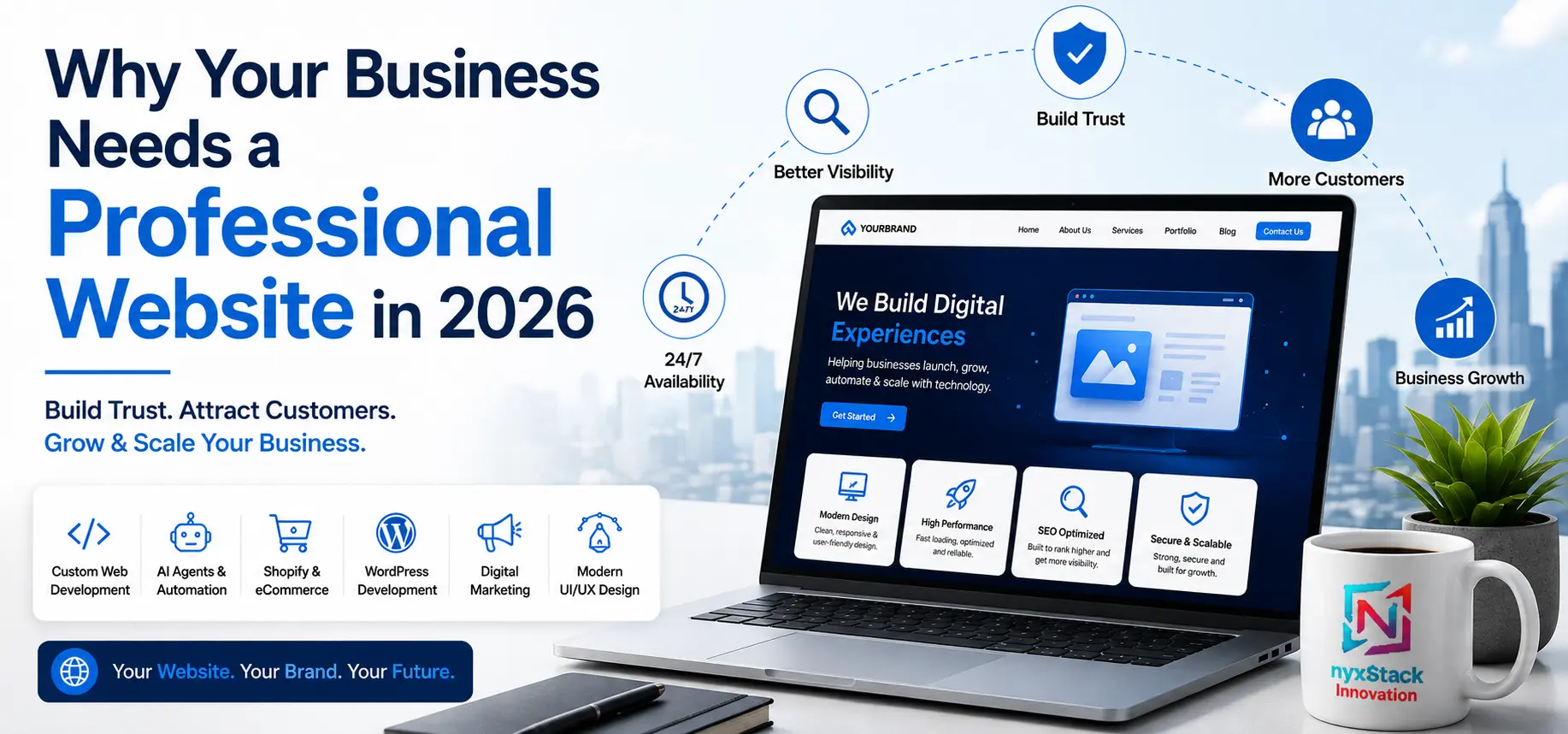
Whether you're a startup, local business, professional service provider, eCommerce brand, or growing company, a professional website can become one of your most valuable digital assets.
A professional website helps your business build trust, control its online presence, attract customers through search engines, generate leads, showcase your products or services, and create a foundation for long-term digital growth.
Your Website Is More Than an Online Brochure
A common misconception is that a website is simply an online version of your business card.
That's no longer true.
A modern business website can function as:
- Your 24/7 sales representative
- Your digital storefront
- Your lead generation system
- Your product catalogue
- Your customer support assistant
- Your brand's first impression
- Your SEO foundation
- Your content hub
- Your booking or enquiry system
- Your connection to other business tools
The difference between a basic website and a professional website is how effectively it helps your business achieve its goals.
1. A Professional Website Builds Trust
Imagine two companies offering the same service.
Company A
They have:
- An Instagram page
- A WhatsApp number
- A few customer reviews
- No website
Company B
They have:
- A professional website
- Clear services & pricing details
- Company information & background
- Case studies
- Verified customer testimonials
- Contact information & enquiry forms
- A professional custom domain
- An active content strategy
Which company would you trust more for a large project?
For many customers, the answer is obvious.
A professional website gives potential customers a place where they can verify your business, understand your services, explore your work, and decide whether you're the right choice.
Your website may be the first detailed interaction a potential customer has with your brand.
A slow, outdated, confusing, or incomplete website can create doubt—even if your actual products or services are excellent.
2. Customers Search Before They Buy
The customer journey has changed. People rarely discover a business and immediately make a purchase.
Instead, the decision-making cycle follows a clear path:
- Discover the business.
- Search for it online.
- Visit its website.
- Compare competitors.
- Read reviews and case studies.
- Check pricing or services.
- Look at previous work.
- Contact the business.
- Make a decision.
Your website serves as an essential bridge between customer interest and conversion. Without one, you give competitors an open opportunity to capture customers who were already interested in what you have to offer.
3. Your Website Helps You Get Found on Google
Social media can generate attention, but search engines generate intent-driven traffic.
Consider someone searching:
"web development company in India"
"best Shopify development company"
"custom website development for real estate"
These searches indicate that the user already has a defined problem, requirement, or budget.
A professionally developed website provides your business with the technical and structural foundation to target these high-intent searches through search engine optimization (SEO).
SEO Starts With Your Website
SEO isn't just about scattering keywords across a page; it's about making your website easy to find, understand, crawl, and navigate.
A strong website gives you complete control over:
- Page titles & meta descriptions
- Logical heading hierarchies (
H1,H2,H3) - Clean, search-friendly URLs
- Internal link structures
- Structured data (Schema.org)
- XML sitemaps & robots.txt
- Image optimization & descriptive alt tags
- Page speed & Core Web Vitals
- Mobile responsiveness
- Content architecture
- Canonical URLs
This creates a rock-solid technical foundation for your broader organic growth strategy.
4. Your Website Works 24/7
Your physical office has opening hours. Your sales team has working hours. Your social media manager has working hours.
Your website doesn't.
A customer can visit your website at:
- 8:00 AM
- 2:00 PM
- 11:00 PM
- Sunday morning
- A public holiday
Your website continuously provides information, collects enquiries, showcases products, accepts bookings, and directs customers toward the next step.
A well-designed website can answer basic questions, explain your services, showcase your expertise, and capture leads even when nobody from your team is online.
5. You Own Your Digital Presence
Social media platforms are valuable—but they shouldn't be your entire digital strategy.
If your business depends entirely on Instagram, Facebook, LinkedIn, or a marketplace, you are building your presence on rented land.
Platforms can change at any time:
- Algorithms and organic reach
- Policies and platform terms
- Feature availability
- Advertising costs
- Content distribution methods
Your website gives you a digital property that you own and control.
You decide:
- What customers see
- How your brand is presented
- What information is available
- How users navigate through the sales funnel
- Where enquiries and leads go
- Which third-party integrations you use
Use social media to build awareness, then direct interested customers to your website for deeper engagement and conversion.
6. A Website Makes Your Business Look More Professional
Brand perception directly impacts your pricing power and closing rates.
Your website communicates authority before a customer ever speaks to a sales representative. Design elements work together to shape that perception:
- Typography: Legible, modern fonts that reflect your industry
- Colors: Cohesive, intentional brand palettes
- Photography: Sharp, authentic imagery rather than generic stock photos
- Layout & Spacing: Clean grids that let content breathe
- Animations: Subtle, purposeful micro-interactions
- Navigation: Intuitive menus that guide users seamlessly
- Visual Hierarchy: Directing eyes to key value propositions
A professional website communicates: "We take our business and our clients seriously." An outdated or broken website communicates the exact opposite.
7. You Can Showcase Your Work Properly
Social media posts disappear down a feed within hours. A website gives your best work a permanent, organized home.
You can create dedicated spaces for:
- Portfolio galleries
- In-depth case studies
- Interactive product demos
- Detailed service breakdowns
- Client testimonials & video reviews
- Verified success metrics
The Problem → Our Solution → The Technology → The Result
This provides potential customers with measurable proof rather than unverified promises.
8. Your Website Can Generate Leads
A website shouldn't just look good—it must encourage visitors to take action.
Depending on your business model, that action might be:
- Requesting a custom quote
- Booking a consultation call
- Calling your sales team directly
- Sending a direct WhatsApp enquiry
- Submitting a detailed RFP
- Purchasing a product online
- Scheduling a live software demo
- Downloading a whitepaper or resource
This is where conversion-focused web design makes all the difference.
Visitors vs Leads
Imagine your website receives 10,000 visitors every month, but generates only 20 enquiries.
Traffic alone doesn't build a business. Your website needs to guide users toward meaningful actions through:
- Compelling, benefit-driven headlines
- Clear, prominent calls to action (CTAs)
- Intuitive navigation paths
- Reassuring trust signals and security badges
- Fast page load times
- Frictionless, mobile-optimized forms
- Strong visual hierarchy that reduces cognitive overload
A professional website is engineered around both user experience and business objectives.
9. Mobile-First Design Is Essential
Your customers aren't only sitting behind desktop computers. They browse on:
- Smartphones on cellular connections
- Tablets in casual settings
- Laptops on the go
- Large ultra-wide monitors
- Multiple web browsers and screen resolutions
A professional website delivers a flawless experience across every screen size through:
- Responsive fluid layouts
- Touch-friendly buttons and tap targets
- Highly readable typography without pinch-to-zoom
- Responsive images optimized for bandwidth
- Streamlined mobile navigation
- Fast, single-column forms
A website that looks great on a laptop but breaks on mobile is an incomplete product that costs you customers every single day.
10. Speed Affects User Experience and Revenue
Nobody enjoys waiting for a slow website to load. Research shows that every additional second of load time significantly increases bounce rates.
Slow websites cause:
- Higher bounce rates
- Frustrated visitors
- Lower engagement and page views
- Abandoned carts and lost leads
- Penalized search engine rankings
Professional web development prioritizes speed from the initial architecture:
- Modern image formats (WebP/AVIF) and responsive compression
- Below-the-fold lazy loading
- Code splitting and tree-shaking
- Minified CSS and JavaScript bundles
- Effective browser caching strategies
- Global Content Delivery Network (CDN) distribution
- Optimized font loading (
font-display: swap) - Server-side caching and efficient backend queries
Performance is not something you paste on at the end—it is built into every layer of code.
11. Your Website Can Automate Your Business Operations
A modern website isn't just an informational storefront—it can act as the operational backbone of your company.
Websites can connect directly to your day-to-day tools:
Website ──► Lead Form ──► CRM ──► Automated Notification to Sales Team
Website ──► Customer Question ──► AI Agent ──► Instant Automated Resolution
Website ──► Product Order ──► Payment Gateway ──► ERP / Inventory Management
When your website handles scheduling, intake forms, invoicing, and support routing automatically, your team saves hundreds of manual hours every month.
12. AI Makes Websites Even More Powerful
Artificial intelligence is transforming how businesses interact with online visitors by making web experiences faster, smarter, and personalized.
Modern websites can integrate:
- AI Chatbots & Assistants: Resolving customer inquiries 24/7 with brand-specific knowledge.
- Intelligent Search: Natural language search that understands intent and typos.
- Smart Recommendations: Recommending relevant products or services dynamically.
- Lead Qualification: Asking preliminary questions to route high-value prospects to sales reps.
- Automated Follow-ups: Triggering personalized emails based on user behavior.
- Behavioral Analytics: Identifying UX bottlenecks and conversion drop-offs.
The real opportunity lies in using AI to solve specific business bottlenecks.
Instead of adding a generic chatbot just because it's trendy, identify where automation can actually save time, reduce overhead, or elevate the customer experience.
13. A Professional Website Gives You a Competitive Advantage
Compare two businesses in your niche:
Competitor:
- Slow loading times
- Broken mobile layouts
- Outdated visual design from 2018
- Thin content with no SEO structure
- Hard-to-find contact details
Your Business:
- Sub-second page loads
- Polished, responsive UI/UX
- Clear value propositions and transparent offerings
- Detailed case studies and client proof
- One-click contact via forms, WhatsApp, or booking links
The difference in credibility is immediate. Your website becomes a decisive competitive differentiator.
14. Your Website Can Grow With Your Business
A well-built website doesn't just address today's needs—it scales with tomorrow's ambitions.
As your business grows, you may want to introduce:
- Customer portals & membership areas
- Multi-currency online payments
- Real-time booking systems
- Subscription management
- Advanced CRM & ERP integrations
- Multi-language localization
- Custom web applications & internal dashboards
A scalable, clean technical architecture ensures these additions are smooth rather than requiring a complete rebuild from scratch.
Professional Website vs Basic Website
| Feature | Basic Website | Professional Website |
|---|---|---|
| Responsive Design | Basic / Inconsistent | ✅ Flawless across all devices |
| Modern UI/UX | Generic template | ✅ Custom, brand-tailored design |
| SEO Foundation | Basic keywords | ✅ Advanced technical & structured SEO |
| Performance Optimization | Unoptimized / Slow | ✅ Sub-second loads & Core Web Vitals |
| Lead Generation | Passive contact form | ✅ Conversion-engineered user flows |
| Analytics & Tracking | Minimal | ✅ Event tracking & behavioral insights |
| Integrations | Limited plugins | ✅ Custom CRM, ERP & API connections |
| AI Integration | Rare | ✅ Brand-trained AI agents & automation |
| Scalability | Rigid | ✅ Highly scalable architecture |
| Security & Privacy | Standard SSL | ✅ Hardened headers, encryption & backups |
| Content Strategy | Static text | ✅ Structured, search-optimized hub |
| Business-focused UX | Rare | ✅ Designed for revenue & retention |
Do Small Businesses Really Need a Website?
Yes—without question. However, the scope and architecture of the website should reflect the business model:
- Local Service Providers: Need service breakdowns, coverage areas, customer reviews, booking calendars, and direct WhatsApp/call buttons.
- eCommerce Brands: Need rich product catalogues, filtering, secure payment gateways, inventory sync, and customer accounts.
- B2B & SaaS Companies: Need product walkthroughs, transparent pricing tiers, API documentation, client logos, and demo booking funnels.
- Consultants & Agencies: Need thought-leadership content, deep case studies, client testimonials, and qualifying consultation forms.
Choosing the Right Website for Your Business
The goal isn't necessarily to build the most complex website—it is to build the website that solves the right problems for your business.
Every company has unique goals, customer behaviors, operational workflows, and growth targets. A local trade business has fundamentally different requirements than a high-volume direct-to-consumer store.
How Much Does a Professional Website Cost?
There is no one-size-fits-all price tag for a professional website because every project is tailored to specific business requirements.
The overall investment depends on:
- Scope of pages and depth of content
- Custom UI/UX design requirements
- Third-party API and database integrations
- Content Management System (CMS) needs
- eCommerce and payment gateway complexities
- Custom AI agents and workflow automation
- Technical SEO and performance benchmarking
- Cloud infrastructure, hosting, and ongoing maintenance
Instead of asking "How much does a website cost?", consider asking: "What return on investment (ROI) should this website generate for our business?"
Once your commercial objectives are clear, selecting the right technology, feature set, and budget becomes straightforward.
Which Website Solution Is Right for You?
No single platform fits every organization. The ideal choice depends on your operational maturity and long-term vision.
1. Website Builders (Wix, Squarespace)
Best suited when:
- You need a simple informational site launched in days.
- You have minimal technical requirements and a tight budget.
- You don't require custom integrations or advanced backend logic.
2. WordPress / CMS Platforms
Best suited when:
- Content marketing and frequent blogging are core to your strategy.
- Your non-technical team needs an intuitive publishing interface.
- You need access to a broad ecosystem of established plugins.
3. Shopify / Dedicated Commerce Platforms
Best suited when:
- Your primary objective is selling physical or digital products.
- You need built-in checkout, tax, and inventory management.
- You want an out-of-the-box, reliable commerce ecosystem.
4. Custom Development (React, Next.js, Modern Stacks)
Best suited when:
- Performance, speed, and Core Web Vitals are critical to your competitive edge.
- You require unique user workflows, customer dashboards, or bespoke features.
- You need seamless integrations with proprietary APIs, ERPs, or CRMs.
- You plan to incorporate custom AI automation and scalable architectures.
The best technology isn't always the most complex one. It is the technology that aligns with your business model, customer expectations, operational budget, and long-term roadmap.
A reliable development partner will recommend the architecture that fits your goals rather than forcing you into a one-size-fits-all solution.
What Makes a Website Truly Professional?
A professional website is defined by how well design, technology, performance, and business strategy converge.
Design
A clean, consistent visual language that accurately reflects your brand identity and inspires immediate credibility.
Performance
Lightning-fast page load times that deliver seamless browsing across diverse network conditions and devices.
Usability
Intuitive navigation that allows visitors to understand what you offer and locate critical information in seconds.
Technical SEO
A clean codebase, structured metadata, semantic HTML, and crawlable architecture that makes indexing effortless for search engines.
Security
Data encryption, secure form processing, regular security audits, and strict compliance to safeguard customer information.
Accessibility (a11y)
Inclusive digital experiences adhering to modern accessibility guidelines, ensuring usability for all individuals.
Scalability
A modular foundation engineered to support rising traffic, expanded catalogues, and new business capabilities without breaking.
Conversion Architecture
Deliberate layout design and compelling value messaging that turns passive browsers into active inquiries and paying customers.
How NyxStack Builds Professional Websites
At nyxStack Innovation, we believe a website should be more than an aesthetic digital brochure—it should be an engine for business growth.
Strategy → UX/UI Design → Development → Performance → SEO → Deployment → Growth
Before writing any code, we take time to understand your commercial goals, target audience, competitive landscape, and operational workflows. This ensures the finished product delivers measurable business value from day one.
We don't believe in cookie-cutter templates.
We analyze your business objectives first, then architect and build a digital solution engineered specifically for your growth.
Our commitment is simple: Build digital experiences that move your business forward.
The Future of Business Websites
Websites are growing more intelligent, interactive, and integrated each year. Today, a modern website serves as your:
- Digital storefront & primary brand ambassador
- 24/7 inbound sales channel
- Central marketing and SEO engine
- Automated customer support layer
- Operational data and lead generation pipeline
- Scalable digital product platform
With AI, automation, personalized journeys, and modern cloud technologies becoming standard, forward-thinking businesses have an unprecedented opportunity to create remarkable customer experiences.
Frequently Asked Questions
Do I need a website if I already have an active Instagram or social presence?
Yes. While social platforms are great for top-of-funnel reach and community engagement, a website gives you full ownership over your brand, content, technical SEO, conversion funnel, and customer data—without being vulnerable to sudden algorithm shifts.
Does every small business need a complex, expensive website?
No. A small business often only needs a fast, professional website that clearly outlines services, highlights verified reviews, builds trust, and makes reaching out effortless.
Can I build my own website using a site builder?
Yes. Drag-and-drop builders are great for basic DIY setups. However, partnering with a professional development team becomes essential when you need bespoke functionality, superior performance, custom CRM/API integrations, advanced technical SEO, and scalable infrastructure.
Can my existing website be redesigned and modernized?
Yes. Existing websites can be revamped to improve UX/UI design, mobile responsiveness, page speed, conversion rates, and technical SEO foundations without losing historical data.
Does every business website need AI integration in 2026?
Not necessarily. AI should only be implemented where it solves an actual business problem—such as automating round-the-clock support inquiries, qualifying incoming leads, or delivering intelligent search.
Final Thoughts
In 2026, a business website is far more than a digital URL or an online brochure. It is the cornerstone of your brand's credibility, the engine of your inbound sales pipeline, and the foundation for long-term digital growth.
A well-crafted website empowers your business to:
- Build unshakeable trust and credibility
- Attract high-intent customers via search engines
- Generate qualified leads around the clock
- Showcase your track record and case studies
- Automate manual operational workflows
- Gain a decisive edge over competitors
Ready to Build a Professional Website That Drives Results?
Whether you are launching a new company, redesigning an outdated site, or building a scalable web application, choosing the right digital partner makes all the difference.
Get in touch with nyxStack to discuss how we can build a high-performing, custom digital presence tailored to your business goals.